
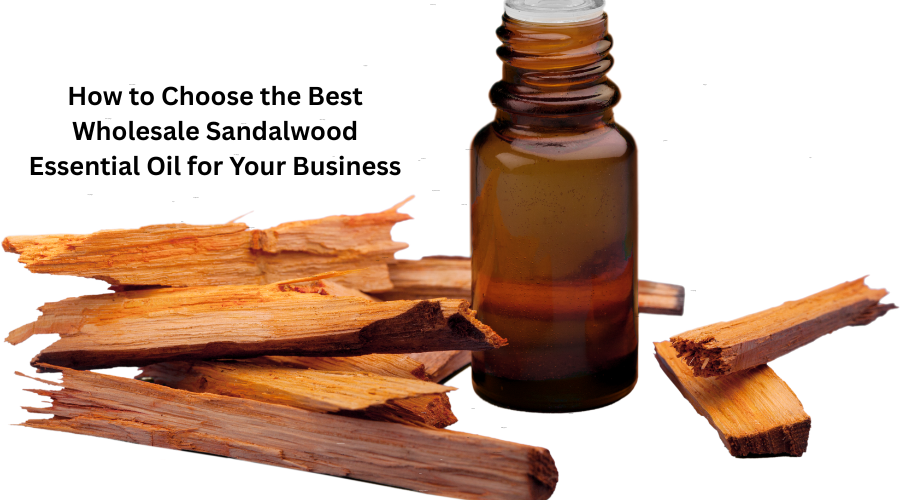
Santalum album, or sandalwood, is popular for lots of health and skincare benefits. Its anti-inflammatory and antimicrobial effects provide lots of help in aromatherapy. That is why people around the world look for it to keep their places fresh and fragrant. However, quality is the biggest concern because searching for authentic sandalwood essential oil is challenging. Many claim to supply authentic and fresh oil, but their claims falter during the shipping process. So, it is better to know how to source original sandalwood essential oil to avoid all the confusion faced by new buyers.
This is the initial step, and the quality is partially based on how these steps take place. The origin and the extraction processes contribute a lot, and it is further supported by the storage process. There are different areas of a sandalwood tree from which extraction is done, but here is what you need to know.
Only heartwood and roots provide the best results upon extraction. Doing that to bark and leaves will not give good results at all. Another factor is the growth of sandalwood, which needs a minimum of 15 to 30 years for a good quality of essential oil.
Experts perform steam distillation of ground and dried heartwood chips for the best results. This process requires 48–72 hours for the desired results.
Then comes shelf life, where a sealed sandalwood essential oil can survive 50 to 10 years. However, an opened essential oil can last hardly 3 to 5 years.
When you are about to source them, make sure you keep this information in mind.
The biggest difference comes from santalol level, which creates varieties. There are mainly two countries that export sandalwood essential oil in massive volumes, and their natures are slightly different from each other. India and Australia are those countries, and their varieties are “santalum album” and “santalum spicatum,” respectively.
Indian sandalwood oil has high santalol content, which is near 80%. Its fragrance is mostly rich and sweet. Australian sandalwood has low santalol content, which is 30%. Its fragrance is dry and woody.
Besides, Indonesian sandalwood essential oil has moderate santalol content. Its fragrance is woody and warm.
Even Hawaii has its own sandalwood essential oil. What makes it different is its strong, pungent, and earthy fragrance. However, its santalol level is higher than the Indian type, which is 90%.
When sourcing essential oil in bulk, choose the origin as per your requirement.
It must be slightly thick and viscous because that is how sandalwood essential oil appears. If it is too thin or too thick, there is a problem with the composition. A transparent or extremely pale color with a thin or watery look shows that there are lots of artificial elements in it.
Dark appearance and murky smell are a sign of a high concentration of other elements. It means you need to avoid that too. The color range from pale to mild yellow is a sign of fresh essential oil. Also, mild yellow and pale shades with slight viscosity are a sign of fresh and light oil.
If it is golden yellow, it means it has a high concentration, and it could be aging. Likewise, golden brown or golden orange indicates super high concentration and aged essential oil.
Choose the mild yellow or pale shade along with little thickness in the texture. That is the ideal quality of sandalwood essential oil.
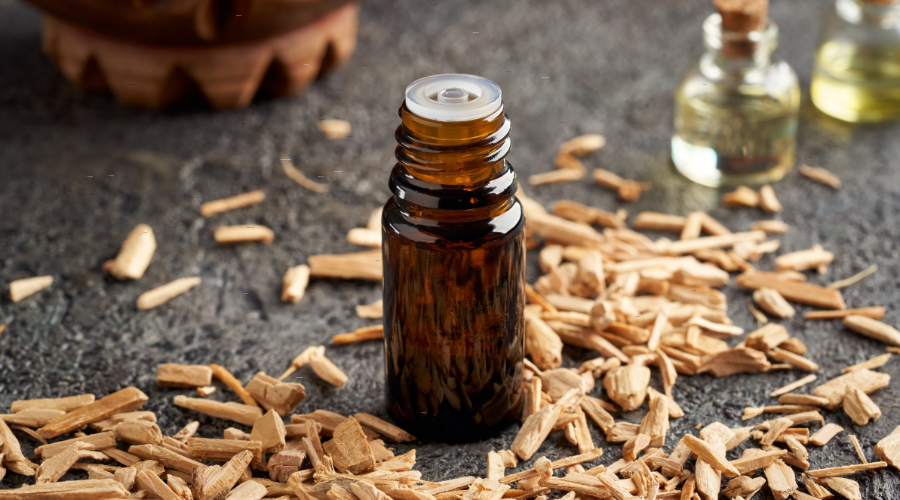
A fresh and authentic essential oil has a woody, warm, sweet, creamy, milky, or soft balsamic fragrance. You can perform a smell test or ask for the composition. If there is a sharp or strong plastic-like smell, it means the oil has additives and unnatural content.
The composition is the key to inspect when you are sourcing sandalwood essential oil. There are elements like alpha-santalol, beta-santalol, epi-beta-santalol, and alpha-bergamotol that contribute to it. Beta-santalol usually provides a sweet fragrance, and every other element contributes differently. Indian, Australian, Indonesian, and Hawaiian essential oils differ in quality because of these factors also.
Alpha-Santalol 40–55%
Beta-Santalol 15–25%
Epi-Beta-Santalol 2–5%
Alpha-Bergamotol 3–8%
Make sure you ask for essential documents from your supplier of sandalwood essential oil. These documents support the claims made by your supplier. You can verify the quality through them, which is why you need to ask your supplier to present them.
GC-MS (Gas Chromatography-Mass Spectrometry) is the first document you need to check. It shows molecular breakdown and percentages of santalol levels like alpha-santalol and beta-santalol. With the help of this document, you can verify the source of essential oil if it is from India, Australia, Indonesia, Hawaii, or from anywhere else. For instance, if it is a Santalum album. It is from India. If it is Santalum spicatum, it is from Australia.
Then you need to ask for a CoA (Certificate of Analysis), MSDS, and an ISO certificate. These documents provide details like batch, lot number, refractive index, storage, fire rating, etc. You will have to ask for IFRA certification also, which ensures that the oil is safe against allergy. This certificate is mandatory if essential oil is being used in skincare or goods that could make skin contact.
Even third-party testing is mandatory, where the supplier will have to provide original documents to back the quality they have. You will also need documents like Country of Origin to ensure that you are sourcing the original essential oil.
When it is about sourcing sandalwood essential oil, you have to make sure you get every mandatory detail for it. Many businesses claim to supply authentic essential oil until they have to prove the quality. This is why you have to know all primary and secondary information about the quality of sandalwood essential oil. Also, what kind of documents are mandatory to back them up should be in your knowledge. Not only is selecting a reliable supplier important, but you have to ensure the authenticity of the oil, too.
Which Documents Support the Quality Claim of Sandalwood Essential Oil?
You need documents like GC-MS (Gas Chromatography-Mass Spectrometry), Certificate of Origin, and Certificate of Analysis. Also, you will need a third-party test report, MSDS, ISO, and IFRA certificates to prove the quality of sandalwood essential oil.
Which Countries are Top Exporters of Sandalwood Essential Oil?
India and Australia are the top exporters of sandalwood essential oil. However, there is a difference in the fragrance and appearance of both countries’ essential oils. Besides, Indonesia and Hawaii also export it, and their oils’ fragrances are also different. This is because of differences in santalol levels in each type.
What are the Quality Indicators to Consider When Selecting Essential Oil of Sandalwood?
A mild yellow or pale shade, along with little thickness in the texture, shows that sandalwood oil is fresh. If the color is dark or extremely light, there is a chance of additives in it. Also, if the smell is very strong, it shows that there are contaminants or a high aging factor in the oil.
How Can I Source Sandalwood’s Essential Oil in Bulk for Aromatherapy?
You can find suppliers that can prove their quality through key documents. Suppliers from countries like Australia, India, Indonesia, and Hawaii have the advantage of exporting authentic sandalwood essential oil. However, you can find some reliable suppliers from other countries also. JiangXi TaiCheng Natural Flavor Co., Ltd. has affordable rates and bulk supply of sandalwood essential oil. You can ask it for documents before importing affordable essential oil from it.

Have a question or need a quote? Fill out this form and our team will get back to you quickly!
 jxtctrxl01@163.com
 15279682788