
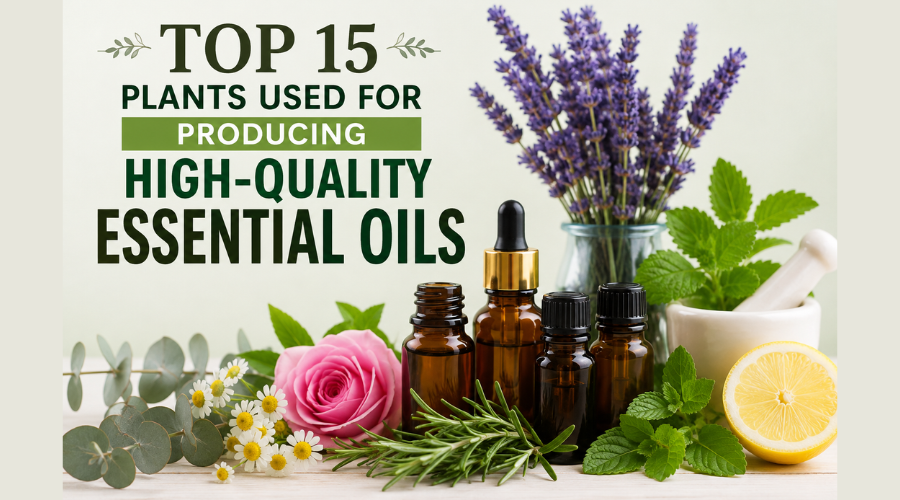
This blog talks about 15 essential oil plants by essential oil yield and quality, from lavender (1-3 percent yield, $30-$60/liter) to rose (0.02-0.05 percent yield, $8,000-$15,000/liter), which is pretty normal if that's such a gap as usual. All plant entries describe their method of extraction, as well as the range of percentage levels of the main aromatic compounds and wholesale prices. It concludes with sourcing suggestions such as timing harvests and asking for GC/MS reports for high-value oils and yielder comparisons before price comparisons.
Essential oils are made from plants. That part is obvious. Not all plants are oil-producing and can be bottled. Others don't produce enough. Some don't contain appropriate chemical compounds. Others don't hold up in extraction. The buyer and the formulator must understand which plants they can depend on for testable, consistent quality on a scale. Here are 15 plants that always yield high-quality essential oils, plus the numbers: Yields, extraction methods, and major constituents.
Not all plants are equal. There can be huge differences in yields. For instance, the oil content of rose is between 0.02% and 0.05% by weight. Lavender is 1 to 3 percent. That explains the cost difference of more than $8,000/liter with rose oil versus lavender, with a price tag of $30 to $60/liter.
The chemical composition is important as well. A plant could be attractive and give no medicinal benefits the buyer is aware of. That's why GC/MS testing was developed. It verifies the actual contents of the bottle, as well as the label's claims.
Steam distillation is possible with most plants. Citrus peels are suitable for cold pressing. Delicate flowers such as jasmine are extracted using a solvent to make something, not a true essential oil, known as an absolute. Avoiding loss in raw material and in yield requires knowledge of the right method for each plant.
Lavender is the best-known essential oil available. It yields 1 to 3 percent oil through steam distillation. It contains its primary compounds, linalool and linalyl acetate, typically in 25 to 45% of the oil volume. The majority of the world's supply comes from Bulgaria and France. The wholesale price is between $30 and $60 per liter, depending on the chemotype and the quality of the harvest.
Peppermint oil contains 0.5% to 1% menthol as a natural steam distillate. The menthol content usually ranges anywhere from 30%-55%, which gives a cooling effect. The wholesale price is $25 per 50 liters.
Tea tree oil comes mostly from Australia. The potential yield is approximately 1- 2 percent. Under ISO 4730 standards, tea tree oil must contain 30–48 percent terpinen-4-ol. The price of the products is variable, ranging from $20 to $40 per liter.
Oil production is approximately 1.5–3% for eucalyptus. It contains a high concentration of eucalyptol, up to more than 70 percent of the composition. It is one of the affordable options on this list with a wholesale price range of $15 to $30 per liter.
Rosemary oil is in the range of 0.5 to 1.5 percent. A large proportion of its profile consists of camphor and 1,8-cineole, sometimes in combination of 30–50 percent. The prices are usually between $20 and 45 per liter.
Why is Rose Oil So Costlier than other oils?
To produce 1kg of rose oil, 4000- 5000 kg of rose petals are needed. They have an extremely low yield, roughly 0.02-0.05 percent, which makes genuine rose otto worth $8,000 per liter to $15,000 per liter.
Not only is rose oil expensive, but it also has more than 300 molecules identified, including Citronellol and Geraniol. Bulgaria's Rose Valley is one of the most sought-after regions in the world; the best time to harvest is during a short period between May and June.
Steam distillation of the dried resin produces approximately 5-8 percent of frankincense. The main components are alpha-pinene and limonene. Resin prices vary widely, grade by grade, ranging from $50 a liter to $150 a liter.
Sandalwood also produces 3-6 percent oil, with santalol content above 90 percent for high-grade oil. Huge demand for real Indian sandalwood has decreased the supply and driven up the price to $300-$600 per liter, while Australian sandalwood is selling for $150-$250 per liter.
German chamomile yields just 0.3 to 1.5 percent oil. It is deep blue in color due to a compound, chamazulene, formed during distillation. Low yield and harvesting difficulty result in prices of $80-$150 per liter.
Harvesting jasmine flowers at night is essential for fragrance. Yield is low, usually below 0.1, and extraction is normally done by solvent methods, not by steam distillation. This produces jasmine absolute, priced between $3,000 and $6,000 per liter.
Steam distillation produces 1.5–2.5 percent of oil from ylang ylang. It can be distilled in fractions, and the “Extra” grade would be the first grade and the highest quality. The prices are $50 to $120 per liter, based on the grade.
Does the time of extraction influence oil quality for flowers, such as Ylang Ylang?
Yes, timing is important! These are more volatile aromatics in the early distillation fractions, known as Extra or Grade 1. Later fractions have higher oily, lower-value notes and thus have a large impact on final value in terms of fraction grading.
Bergamot is cold-pressed from citrus peel, and produces approximately 0.5 percent oil. It has a major content of linalyl acetate and limonene. Prices range from $40 to $80 per liter; bergapten-free ones may cost more due to extra processing.
Clary sage contains 0.5 to 1 percent oil through steam distillation. The content of linalyl acetate can be 60 to 75 percent. Wholesale prices are about $60 to $100 per liter.
Patchouli produces between 2 and 3 percent oil, and actually gets better with age, unlike other oils. Typically, patchoulol content is between 25 and 35 percent. The price range is $40-$90 per liter, with aged batches being sold at higher prices.
Lemon oil is cold-pressed from the peels, with an oil content of 0.3 to 0.5 percent. It is composed of 60-80 percent limonene. One of the less expensive oils is in the range of $30 or so, from $15 to $30 per liter.
There is a significant variation in yield rates in this list. Sandalwood and frankincense are at the top of the range at 3-8 percent. Jasmine and rose will be at the lowest end, say below 0.1 percent. This is the key factor for most of the price spread the buyers observe in the essential oil market.
Buyers should learn about yield before they compare prices.
A buyer who is looking at rose oil at $50 a liter and one that's being sold for $10,000 a liter by a legitimate supplier is not considering the same product. Buyers need to be aware of yield rates to avoid placing large orders at unrealistic prices.
The Sourcing Guidelines for Bulk Buyers
When purchasing these oils in bulk, one must be mindful of which parts and when to harvest for the highest concentrations of the oils. Lavender is harvested from late June to August. Rose is harvested in May and June. Missing these windows often means relying on previous season stock.
Verify authenticity before purchase.
For higher-value oils such as rose, jasmine, and sandalwood, ask for their GC/MS reports. Compound percentages should be within the range known for that botanical, following known standards such as ISO if available.
These are the 15 plants that are among the most dependable for high-quality essential oils that are currently available. Yield rates, chemical composition, and timing influence quality and market value. Buyers informed about these numbers make better decisions when buying oil and don't over- or underpay for oil delivered from a source that isn't their true one.
Where can I purchase essential oils wholesale for retail?
The best way to purchase in bulk is to go through a certified supplier that offers a GC/MS report for each botanical. Before ordering a large quantity of any plant, make sure that the yield-based pricing matches the type of plant.
How to buy essential oils wholesale at affordable rates?
Consider prices from multiple reputable suppliers in the same plant category, as yield rates differ significantly among botanicals.
Will any essential oil suppliers also let me customize the oil?
Seek out suppliers that provide custom blends, sourcing a specific chemotype, or private-label bottling. For bulk and formulation buyers, the many essential oil manufacturers provide these options themselves.

Have a question or need a quote? Fill out this form and our team will get back to you quickly!
 jxtctrxl01@163.com
 15279682788